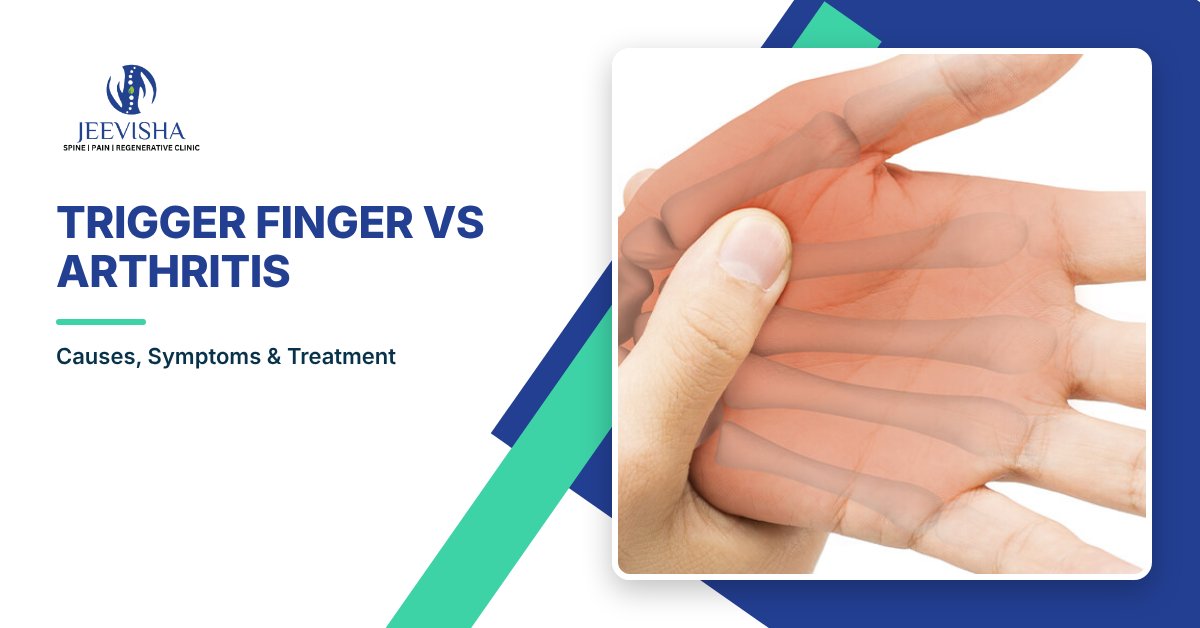
Trigger finger and arthritis are different conditions. Trigger finger affects a tendon and typically causes one finger or thumb to catch, click or lock. Arthritis affects joints and more often causes aching, swelling and stiffness. They can occur together, and an examination is the most reliable way to tell them apart.
If your finger catches when bending, gets stuck in a bent position or suddenly pops straight, trigger finger is a strong possibility. If several knuckles ache, look swollen or feel stiff, arthritis may be more likely. Neither pattern is certain enough for a diagnosis at home.
Finger problems can interfere with typing, cooking, using tools, playing an instrument, gripping a racket or opening a bottle. A trigger finger assessment can confirm whether the problem comes from a tendon, a joint or another structure.
What is trigger finger?
Trigger finger, also called stenosing tenosynovitis, is a problem with the tendon that bends a finger or thumb. The tendon normally glides through a short tunnel of tissue called a sheath or pulley near the base of the finger.
When the tendon or pulley becomes irritated and thickened, there is less room for smooth movement. A small nodule may form on the tendon. As that thickened area passes through the tight pulley, it can catch, click, snap or become stuck. This explains why a finger may suddenly lock when you bend or straighten it.
What are the typical symptoms of trigger finger?
- clicking, popping or catching when the finger or thumb moves;
- a finger stuck in a bent position that may need the other hand to straighten;
- pain or tenderness in the palm at the base of the affected finger;
- a tender bump near the base of the finger on the palm side;
- stiffness that is often worse on waking; and
- pain when gripping, squeezing or holding an object.
Trigger finger can affect one or more fingers and can occur in either hand. The key clue is mechanical catching or locking, not simply pain.
What is arthritis in the fingers?
Arthritis affects joints rather than the tendon pulley. Two important forms are osteoarthritis and rheumatoid arthritis, but other inflammatory conditions can also affect the hands.
What does hand osteoarthritis feel like?
Osteoarthritis can cause joint pain, stiffness, tenderness, reduced movement and a grating or crackling sensation. Finger joints may look larger or knobbly, and bumps can develop around the joints. It often affects the base of the thumb, the middle finger joints or the joints nearest the fingertips.
What does rheumatoid arthritis feel like?
Rheumatoid arthritis is an inflammatory condition. The small joints of the hands are often affected, sometimes on both sides. Joints may feel painful, swollen, warm and stiff, especially in the morning or after inactivity. Some people also have tiredness, feverishness, reduced appetite or weight loss.
Morning stiffness can occur in both arthritis and trigger finger. The difference is that trigger finger tends to produce a specific catch or lock, while arthritis causes joint-centred stiffness, pain and swelling. The duration of morning stiffness can help a doctor, but it does not confirm the diagnosis by itself.
Trigger finger vs arthritis: how are they different?
- Structure affected: trigger finger involves a flexor tendon and its pulley; arthritis affects a joint.
- Main movement clue: trigger finger catches, clicks, snaps or locks. Arthritis more often makes a joint ache, swell, feel stiff or lose movement without the classic tendon catch.
- Pain location: trigger finger is often tender in the palm at the base of one finger. Arthritis pain is centred around one or more joints or knuckles.
- Number of areas: trigger finger often draws attention to one digit, although several can be affected. Arthritis may involve several joints and, in rheumatoid arthritis, may affect both hands in a broadly similar pattern.
- Swelling: trigger finger may produce a small tender lump near the palm-side base of the finger. Arthritis more often causes joint swelling, warmth or knobbly changes.
- Morning pattern: both can be worse after rest. Trigger finger often loosens after the digit begins moving, while inflammatory arthritis may cause more widespread and lasting morning stiffness.
- Risk clues: repetitive gripping, diabetes, thyroid disease and rheumatoid arthritis increase the likelihood of trigger finger. Arthritis has its own causes and risk factors.
A click alone is not enough to decide. Joint cracking without pain is different from a finger that repeatedly catches at the same point. A clinician can feel the tendon move, examine the joints and decide whether imaging is needed.
Is trigger finger a type of arthritis?
No. Trigger finger is a tendon-and-pulley disorder, while arthritis affects joints. The names describe different problems. However, osteoarthritis and rheumatoid arthritis are recognised risk factors for trigger finger, so one person can have both conditions.
Can trigger finger and arthritis happen together?
Yes. Arthritis may cause joint pain and swelling while trigger finger causes a separate catching sensation in the same hand. Treating one does not automatically treat the other. This is why the exact tender spot and the movement that triggers symptoms matter during an examination.
What else can cause a finger to lock, click or hurt?
Dupuytren's contracture
Dupuytren's contracture affects the fascia just under the skin of the palm. Thickened tissue or a cord gradually pulls one or more fingers towards the palm. Unlike trigger finger, it does not usually produce a sudden catch or snap. The finger becomes progressively difficult to straighten, while making a fist may remain possible.
Ganglion cyst
A ganglion cyst is a fluid-filled lump near a joint or tendon. It may change in size or cause aching and pressure. A lump alone does not prove trigger finger, and a clinician may need to distinguish a cyst from tendon thickening or an arthritic change.
Recent injury
A sprain, fracture or tendon injury can cause sudden pain, swelling, bruising or loss of movement. If symptoms began with a fall, impact, forced bend, pop or visible deformity, do not assume it is trigger finger. Arrange prompt assessment.
Nerve problems
Numbness, tingling, burning or marked hand weakness points more towards nerve involvement than uncomplicated trigger finger. The clinic's elbow and wrist pain page covers related upper-limb symptoms that may need a broader assessment.
What causes trigger finger?
Often there is no single clear cause. The problem is associated with irritation and thickening of the tendon or pulley. Factors that can increase the likelihood include:
- Repeated or forceful gripping: manual tools, farming, gardening, some musical instruments, racket sports and repeated squeezing can load the tendon.
- Work and exercise: gym grips, tool handles or a sudden increase in hand-intensive activity may aggravate symptoms. These workout-related elbow and wrist pain tips explain why load changes matter across the upper limb.
- Diabetes: people with diabetes have a higher risk, but diabetes does not mean every stiff or swollen finger is trigger finger.
- Rheumatoid arthritis and osteoarthritis: both are associated with a higher likelihood of trigger finger.
- Thyroid disease and some other health conditions: these may also increase risk.
Typing involves repetition but not always the forceful gripping most often linked with trigger finger. It may aggravate an already sensitive finger, especially if the hand stays tense, but it should not be treated as the only explanation without an examination.
What self-care can you try first?
Self-care is reasonable for mild, recent symptoms when the finger is still moving and there are no warning signs. It should not involve repeatedly forcing a locked finger straight.
- Identify the aggravating grip. Notice whether tools, weights, racket handles, cooking tasks, instrument practice or repeated squeezing bring on the catch.
- Reduce that activity temporarily. A one-to-two-week reduction in the triggering hand activity may settle irritation. If work cannot stop, shorten gripping periods, switch tasks and use wider or padded handles where practical.
- Consider a night splint. A correctly fitted splint can keep the digit straighter during sleep, especially when morning locking is the main problem. Avoid an improvised tight splint that causes numbness, colour change or swelling.
- Keep movement gentle. Slowly bend and straighten within a comfortable range. Stop before a painful catch and do not use the other hand to force the joint repeatedly.
- Use cold only for comfort. A wrapped cold pack may soothe soreness or swelling after activity, but it does not remove the mechanical narrowing. Stop if the skin becomes painful or numb.
- Use pain relief carefully. If an over-the-counter painkiller is normally safe for you, follow the pack instructions. Ask a pharmacist or doctor if you are pregnant, take other medicines or have a health condition.
A physiotherapist in Wakad can check movement, teach appropriate exercises and help adapt hand use. Exercises should match the diagnosis; an arthritic joint and a catching tendon may need different advice.
Finger catching or locking?
Get your hand assessed at Jeevisha Pain Management Center, Kalewadi Phata, Wakad.
When might professional treatment be needed?
Book an assessment if the catching is persistent, worsening, limiting work or daily tasks, or not improving with activity changes. Trigger finger is often diagnosed from the history and examination. Ultrasound or an X-ray may be used when the diagnosis is unclear or another problem is suspected.
Depending on the diagnosis and severity, professional treatment may include:
- guidance on activity modification and splinting;
- hand therapy or physiotherapy;
- a steroid injection for trigger finger to reduce swelling around the affected tendon;
- arthritis treatment directed at the affected joint or inflammatory condition; or
- a release procedure for persistent or severe trigger finger when conservative treatment has not helped.
An injection is not the same for every hand condition. Trigger finger involves a tendon pulley, while arthritis is joint-centred. Jeevisha's page on ultrasound-guided intra-articular injections describes a joint-injection service; a clinician must first decide whether the painful structure is a joint and whether that option is appropriate.
Jeevisha Pain Management Center lists trigger finger among its treated conditions and has an in-house physiotherapy team. This does not mean every locked finger needs an injection or procedure.
When should you see a doctor?
Arrange a routine consultation if pain or locking is getting worse, keeps returning, does not improve with self-care, or stops you typing, dressing, cooking, driving, using tools or doing other normal activities. Also seek review if several joints are swollen, both hands are affected, or you have diabetes and a new hand problem.
Seek urgent medical care if:
- a finger is suddenly stuck and cannot be straightened, even with gentle help;
- you suddenly cannot move or use the finger;
- the finger or hand is severely swollen, red or hot, especially with fever or feeling unwell;
- there is numbness, major weakness or a colour change;
- pain began after an injury with a snap, deformity or major bruising; or
- a ring is becoming tight on a rapidly swelling finger.
What should you track before the appointment?
- which finger or thumb is affected and on which hand;
- whether it catches while bending, straightening or both;
- whether you can straighten it without the other hand;
- the exact location of tenderness or swelling;
- whether symptoms are worse in the morning;
- work, sport, instrument or household activities that trigger it;
- numbness, weakness, fever, injury or other swollen joints;
- diabetes, thyroid disease, arthritis and current medicines; and
- what self-care you tried and whether it helped.
How can you reduce the chance of trigger finger getting worse?
Trigger finger cannot always be prevented because many cases have no single clear cause. These steps may reduce repeated irritation:
- break up long periods of gripping or squeezing;
- avoid suddenly increasing tool, gym, racket or instrument practice;
- use a relaxed grip and wider handles where possible;
- alternate hands or tasks instead of loading one finger continuously;
- stop and adjust when catching begins rather than repeatedly forcing through it;
- follow a clinician's advice for diabetes, thyroid disease or inflammatory arthritis; and
- continue only the stretches or splint routine recommended for your diagnosis.
Frequently Asked Questions
Is trigger finger a type of arthritis?
No. Trigger finger affects the tendon and pulley that help a finger bend and straighten, while arthritis affects a joint. Both can cause pain and morning stiffness, but catching or locking is more typical of trigger finger. Arthritis can increase the risk of trigger finger, so the two conditions may occur in the same hand.
Why does my finger lock when I bend it?
In trigger finger, an irritated or thickened tendon does not glide smoothly through its pulley near the base of the finger. The tendon or a small nodule can catch at the narrowed point, making the finger click, stick or lock. Injury, Dupuytren’s contracture and other problems can also restrict movement, so persistent locking needs examination.
Can arthritis and trigger finger happen together?
Yes. A person may have arthritis-related pain and swelling in the finger joints as well as a separate trigger finger affecting a tendon. Osteoarthritis and rheumatoid arthritis are also associated with a higher likelihood of trigger finger. The location of tenderness, the joints involved and whether the finger catches help a clinician separate the two problems.
Does diabetes cause trigger finger?
Diabetes is a recognised risk factor, but it does not directly explain every case. People without diabetes can also develop trigger finger, and many people with diabetes never do. If you have diabetes and new finger locking, swelling or reduced movement, arrange an assessment rather than assuming the symptom is harmless or automatically diabetes-related.
What is the difference between trigger finger and Dupuytren’s contracture?
Trigger finger is a tendon-pulley problem that causes a painful catch, click or lock during movement. Dupuytren’s contracture involves thickened fascia beneath the palm, often forming a visible cord that gradually pulls a finger down. It usually limits straightening without the sudden snap of trigger finger, while making a fist may remain possible.
Which doctor should I consult for finger pain or locking?
A primary-care doctor, musculoskeletal clinician, pain specialist, orthopaedic or hand specialist can begin the assessment, depending on local access and the symptoms. Inflammatory joint swelling may also need a rheumatology opinion. Seek urgent care rather than a routine visit if the finger suddenly cannot move, looks deformed, or is red and hot with fever.
Why is my finger swollen and painful to bend?
Trigger finger can cause pain, stiffness and a tender lump near the palm-side base of a finger. Arthritis more often produces swelling around a joint. Injury, infection, a cyst and other tendon problems can look similar. Rapid swelling, marked redness or heat, fever, numbness, deformity or inability to move the finger needs prompt medical care.
Can trigger finger improve without surgery?
Many cases are managed without surgery using activity changes, rest, a suitable splint, guided exercises or an injection when appropriate. Surgery is generally considered when symptoms are persistent or severe and conservative treatment has not helped. The right option depends on how far the finger moves, how often it locks and the confirmed diagnosis.
Where can you get help for a locking finger in Pune?
For persistent finger catching, locking or hand joint pain in Pune or Pimpri-Chinchwad, you can consult Dr. Sanjog Mekewar, an Interventional Pain Management specialist, at Jeevisha Pain Management Center. The clinic can assess whether symptoms fit trigger finger, arthritis or another source of hand pain.
The clinic is at Shop No. 214, Solitaire Business Hub, Kalewadi Phata, Wakad, Pune 411057. Hours are Monday to Saturday, 10:00 AM to 8:00 PM; Sunday closed. Phone or WhatsApp: +91 91191 11837.
Book a hand pain consultation
Jeevisha Pain Management Center, Shop No. 214, Solitaire Business Hub, Kalewadi Phata, Wakad, Pune 411057. Open Monday to Saturday, 10:00 AM to 8:00 PM.
Sources
- Cleveland Clinic. Trigger Finger: What It Is, Symptoms, Causes & Treatments.
- Mayo Clinic. Trigger finger: Symptoms and causes.
- Hospital for Special Surgery. Trigger Finger and Trigger Thumb.
- NHS. Trigger finger. Last reviewed 17 November 2025.
- NHS. Osteoarthritis: Symptoms. Last reviewed 20 March 2023.
- NHS. Rheumatoid arthritis: Symptoms. Last reviewed 8 March 2023.
This article is for general information and does not replace a medical consultation. Please see a doctor for advice about your own symptoms.